

The Monkey Trap
Can Modern Money Theory Solve the Dilemma of Oil Reserves & Climate Collapse?

One of the biggest roadblocks on our way to avoiding Climate Collapse lies in the fact that world oil and gas reserves—the known quantities of oil and gas that are (a) still in the ground and (b) OWNED by fossil fuel companies—represent many trillions of dollars in assets on the balance sheets of those companies. These are assets the companies have already “banked on,” borrowed against, and cannot imagine leaving in the ground because they represent the future cash flow and profits the companies’ shareholders—by ownership and by law—expect to receive.
To keep this simple, let’s leave out natural gas and just consider the known oil reserves which are estimated to be 1.7 trillion barrels. With an average profit of $20 per barrel, these oil reserve assets owned by fossil fuel companies represent $34 trillion! These are profits that will be realized over the next 50 years—which is how long 1.7 trillion barrels will last at the rate of present-day, world-wide consumption.
As pointed out by A.J. Horn in his recent Substack essay, “Climate Collapse is Not an Accident,” extracting and burning the world’s oil and gas reserves will push global warming far beyond the 2 degrees Celsius climate scientists have identified as the tipping point for Climate Collapse. The dilemma is that abandoning these fossil reserves—which is what climate scientists are clearly saying is essential—will, under current bookkeeping logic, lead to the financial collapse of the oil and gas companies and, by extension, much of the “infrastructure” of capitalism itself. Facing this calculated demise, the world of financial capitalism is paralyzed, like a deer in the headlights of an oncoming tractor-trailer, unable to even think how to get out of the way.
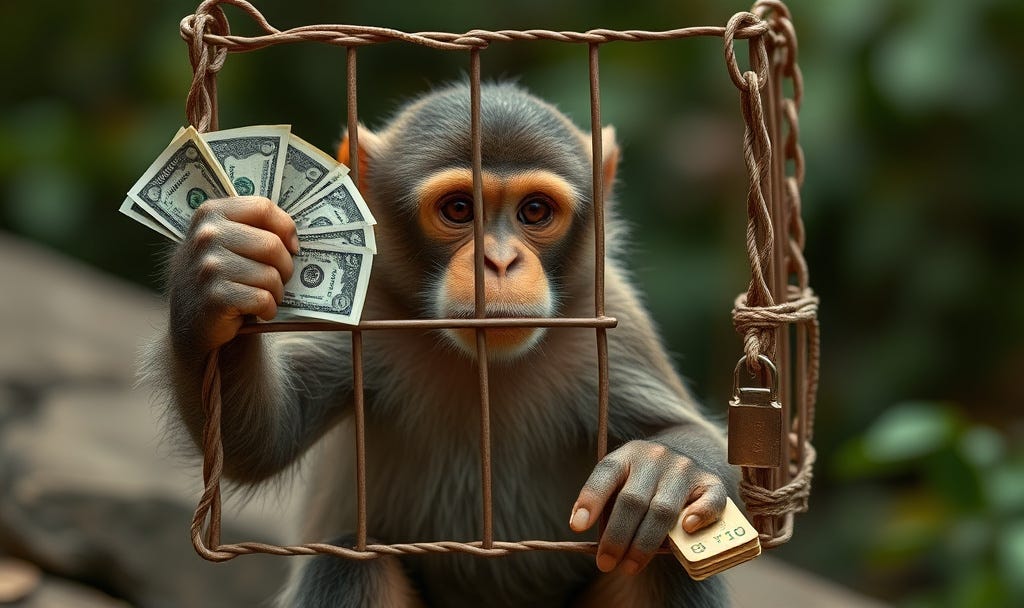
What this dilemma brings to mind is the simple monkey trap of Southeast Asia consisting of a basket cube with a hole just big enough for a monkey to slide its hand through. The basket is tied to a heavy rock with a precious morsel of food inside. The monkey comes along, slides its hand into the basket and grasps the morsel. But the monkey’s fist around the food is now too large to come back OUT of the basket! The monkey is trapped—unless it is willing to let go of the food! And there has never, ever, been a monkey willing to do that—even when the trap-setter approaches and looms over the terrified creature with a club in his hand.
What deserves real consideration here is the fact that this dire crisis of potentially-stranded oil reserves exists primarily because the world of financial capitalism has, thus far, refused to acknowledge and embrace the mechanisms of modern fiat money. Those mechanisms have been operating, full swing now, for well over half a century, but have barely broken through the curtain of money “consciousness” that, like the curtain hiding the Wizard of Oz, has yet to be successfully thrown open.
I do not presume to be the person to accomplish that feat, but I can’t avoid engaging in a short thought-experiment about how Modern Money Theory—the explanation of the mechanisms of modern fiat money—might tackle Big Oil’s dilemma with the monkey trap it has its fist stuck in.
Two Scenarios for Fossil Reserves
Let’s consider two alternative scenarios for the disposition of the oil reserves we’ve just described. For the sake of simplicity, let’s imagine they’re all owned by the “American Fossil Fuel Co.”—AFFCO. (Note: the fact that the current “American President” appears to be pursuing this as an actual goal is pure coincidence here.)
SCENARIO A
In the year 2027, AFFCO extracts 50 billion barrels of oil reserves and sells it on the market for a profit of $1 trillion.
To “monetize” this profit in the Federal Reserve’s clearing and payments process—i.e. to ensure there are adequate fiat dollar Reserves to clear the aggregate bank-dollar payments as the oil is purchased—the FED issues, over time, $1 trillion in new fiat dollar Reserves.
The new Reserves are credited to the Reserve Accounts of the various banks involved in the oil transactions in exchange for $1 trillion in Treasury bonds held by the banks. The FED puts these bonds on its balance sheet as it issues the new Reserves. (One dollar’s worth of securities on this side—one new fiat dollar issued on the other.)
The extracted 50 billion barrels of oil are burned, emitting 20 billion metric tonnes of CO2 into the atmosphere and pushing global temperatures 8% closer to Climate Collapse. (It is estimated that the world can only emit another 250 billion tonnes of CO2 before temperatures rise above the tipping point of 2 degrees Celsius.)
SCENARIO B
In the year 2027, AFFCO formally and permanently SEQUESTERS and leaves in the ground 50 billion barrels of its oil reserves.
The American people (i.e. the U.S. government) purchase the sequestered oil from AFFCO for $1 trillion.
To make payment for the sequestered oil, the U.S. Treasury issues $1 trillion in new bonds which the Federal Reserve purchases on the open market using new fiat dollars it issues for the purpose.
AFFCO pockets the $1 trillion profit (since the oil is left untouched, there are no “upstream” or “downstream” costs) makes distributions to its shareholders and invests the rest in creating future non-fossil-based revenue streams.
The FED puts the $1 trillion in new Treasury bonds on its balance sheet.
The 50 billion barrels of oil reserves never see the light of day, and the world is 8% further away from Climate Collapse.
The question now for consideration is this: Why does the world of financial capitalism not believe that Scenario B is a viable option—especially given the dire consequences of dismissing it?
“Debts” must be Repaid
Some will say that Scenario B is not an option because the issuing of the new Treasury bonds to buy the fossil reserves will dramatically increase the U.S. federal “deficit” and “national debt” requiring a dramatic INCREASE in taxes to repay the “debt.”
But Modern Money Theory shows us that if the Federal Reserve purchases the new bonds and puts them on its balance sheet the increased “debt” the government owes is essentially to itself—and paying itself principal and interest is like buying something it already owns. This means the “deficit” becomes meaningless—because no new taxes need be collected to pay interest on the bonds—and the bonds, themselves, can be “rolled off” the FED’s balance sheet at any time, in effect cancelling them.
Some will respond to that explanation by saying it is illegal and unprecedented for the FED to buy the bonds as described—that doing so will destroy the U.S. bond market sending the world economy into a tailspin. But it is legal for the FED to buy the bonds on the open market, just as it did during the 2008 financial crisis when it issued new fiat dollars to purchase $1.75 trillion in securities to replace the fiat dollars banks lost in the subprime mortgage fiasco. And this was not the first precedent: The U.S. paid for its World War II efforts with 5.7 trillion fiat dollars (in today’s currency) issued out of thin air by exactly the same process just described.
Runaway Inflation
The next line of attack on Scenario B is that it will generate runaway inflation because it creates new fiat money without creating anything for that money to buy.
In Scenario A, the new fiat dollars created in the FED’s payments-clearing process have something new to purchase—the energy produced by burning the newly extracted oil. But in scenario B the new fiat dollars also have something purchase—the formal guarantee that the oil will never be extracted and burned. Inflation-wise, what is the difference? In each case the new fiat dollars are passed on to AFFCO and its investors from where they enter the general economy. It is difficult to see how one Scenario is more inflationary than the other.
Consequences?
The consequences of Scenario A seem clear: The monkey—along with everyone else in the world—will get clobbered long before the oil reserve assets can be cashed in. In contrast, what are the consequences of Scenario B?
Well, first, of course, the world will be spared the catastrophe of Climate Collapse. If Scenario B is implemented every year for 34 years, by the year 2061 all the world’s fossil fuel reserves will have been sequestered—along with the 700 billion metric tonnes of CO2 that would have pushed global temperature rise well beyond the 2 degrees Celsius tipping point. In accomplishing that, however, a great many other virtuous things might happen as well:
AFFCO, for example, instead of having gone bankrupt, will have changed its name to the “American Climate Restoration Co.” (ACRECO)—and will have used its $1 trillion in yearly profits to, among other virtuous things:
Transition research, development, and production to non-fossil-fuel energy systems and products.
Develop and build carbon-capture systems that suck CO2 out of the atmosphere.
Develop and produce new zero-energy building materials and industrial processes.
Implement an Employee Stock Ownership Plan (ESOP) which will give employees a governing majority stake in the corporation.
A Final Question to be Considered:
Is the author of this Substack crazy?
How is it possible for an architect (motivated fifteen years ago to discover and understand how the 2008 subprime mortgage/financial crisis derailed his highest aspirations)—how is it possible that what he has outlined here describes a viable reality the world could actually follow to solve its biggest dilemma?
If what has been outlined in Scenario B is truly a viable option, why haven’t the thousands of scholars, policymakers, and economists attending the climate-change summits in Kyoto, Paris, and Barcelona said so? Why has the Managing Director of the International Monetary Fund NOT given a speech outlining the possibilities? Why hasn’t the Intergovernmental Panel on Climate Change calculated and called for the strategy to be implemented in its reports?
I don’t really have an answer. The only one I can even think of is that humans have not evolved beyond the Monkey nearly as far as we like to imagine.
After all that gloom, you still have a sense of humor, John. But it also represents an all too common theme right now: “the people” have solutions but those in power just don’t want them. Still, we persist.
Love this assessment, though I don't think many of the monkeys in government are going to be letting that morsel go anytime soon! That said, I do think there are other paths that will allow us to achieve some of the things you're pointing to. Working on one now! Anyway, really appreciate your take on this.